How to increase your borrowing power
Some changes are worth tens of thousands of dollars of borrowing power and cost you nothing. Others that people try first do nothing at all. Here they are, priced.
Figures at the median variable rate on 10 October 2026, from the same model as our borrowing power calculator.
A lender works out your borrowing power from what's left of your pay each month after tax, living costs and debts, tested at a rate 3% above today's. To raise it, you either increase what comes in, reduce what a lender counts going out, or wait for the rate to fall. Some of those are worth far more than others.
Two buyers, to put prices on it. Sam: single, $98,000, a $6,000 credit card, spending $2,500 a month apart from rent. Borrowing power: about $436,000. Alex and Jo: $90,000 and $70,000, one child, $10,000 of card limits, a $400-a-month car loan, spending $4,800 a month. Borrowing power: about $611,000.
What works, priced
| Change | Sam | Alex and Jo |
|---|---|---|
| Close or cut credit card limits to nothing | +$27,000 | +$46,000 |
| Pay off the car loan | No car loan | +$48,000 |
| Bring spending down to the lenders' benchmark | +$53,000 | +$28,000 |
| A 0.25% rate cut | +$10,000 | +$14,000 |
1. Close the credit cards you don't use
Lenders count a card at its limit, not its balance, commonly as 3.8% of the limit every month. Each $1,000 of limit costs about $4,600 of borrowing power, whether you've spent a cent or not. Closing a card, or asking for a lower limit, is free, quick and the biggest easy win for most buyers. Do it before you apply: a closed card can take a few weeks to drop off your file.
2. Clear small loans, especially car loans
Car and personal loans count at their full monthly repayment, and a repayment shrinks your surplus dollar for dollar. If you can clear a small loan with savings you don't need for the deposit, it's often worth more in borrowing power than it costs. Run both: what clearing it adds to the loan, and what it takes from the deposit.
3. Get your spending to the benchmark, and no lower
Lenders use the higher of what you spend and a benchmark for a household like yours. Above the benchmark, every dollar a month you cut adds about $121 of borrowing power. At the benchmark, cutting further does nothing: the lender uses the benchmark anyway. Three months of tidy statements before you apply is what shows it.
4. Count every income
A second income on the application adds a lot: a partner on $40,000 adds about $147,000 to Sam's figure. Bonuses and overtime count too, usually at 80%, if they're regular and documented: a $10,000 annual bonus adds about $37,000. Rental income from a property you own counts at about 75%.
5. Ask about HECS if it's nearly paid
Lenders count the compulsory HECS repayment as a monthly cost, but they're allowed to ignore it if it will be repaid within about 12 months. If yours will, ask. See does HECS affect borrowing power.
What doesn't work
- A bigger deposit. It raises the price you can pay and can avoid mortgage insurance, but borrowing power comes from income and costs. The loan a lender will offer doesn't change.
- Spending less than the benchmark. The lender uses the benchmark if it's higher than your real spending.
- Applying to lots of lenders. Each one tests you the same way, with the same 3% buffer. Several applications in a row can also count against you on your credit file.
- Leaving debts off a calculator. It flatters the estimate, not the approval. Lenders check your credit file, statements and payslips.
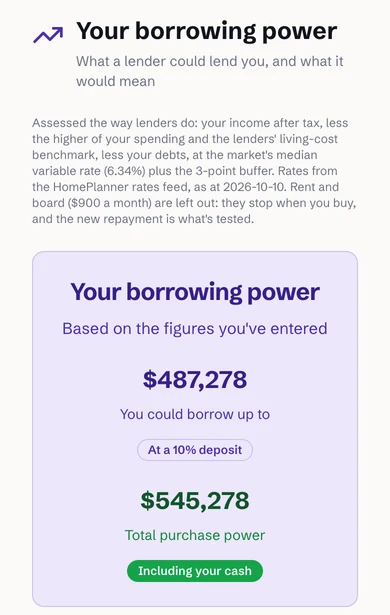
- How it's worked out: today's median variable rate plus the 3-point buffer lenders test at
- What a lender would lend, at your deposit size
- What you could buy, with your cash on top
Questions people ask
Does a longer loan term increase borrowing power?
In principle, but most lenders already assess over 30 years, the usual maximum for a new home loan, so there's rarely anything left to gain.
Does a guarantor increase borrowing power?
Not directly. A guarantor's security can stand in for part of your deposit and avoid mortgage insurance, but the lender still has to be satisfied you can repay from your own income.
Will my borrowing power go up if rates fall?
Yes. Each 0.25% fall lowers the rate you're tested at too, adding about $10,000 for Sam.
How long before applying should I make these changes?
Two to three months is a good rule: long enough for closed cards to show on your credit file and for your statements to reflect your spending.