How much can I borrow on my salary?
Roughly five times your income if you have no debts or children, less with them. Here it is salary by salary, worked out the way lenders do it.
Figures at the median variable rate on 10 October 2026, from the same model as our borrowing power calculator.
At today's rates, a lender could lend a single person with no debts or children a little over five times their income: about $528,000 on $100,000. It isn't really a multiple. Lenders work out what's left of your pay after tax, living costs and debts, and the loan that leftover could repay at a rate 3% above today's. Children, debts and spending above the benchmark all bring it down.
Single
| Salary | No children | One child |
|---|---|---|
| $50,000 | $253,000 | $198,000 |
| $60,000 | $306,000 | $252,000 |
| $70,000 | $361,000 | $306,000 |
| $80,000 | $416,000 | $362,000 |
| $90,000 | $472,000 | $418,000 |
| $100,000 | $528,000 | $474,000 |
| $120,000 | $628,000 | $575,000 |
| $150,000 | $775,000 | $723,000 |
| $200,000 | $1,002,000 | $951,000 |
Couple
| Household income | No children | Two children |
|---|---|---|
| $100,000 | $467,000 | $376,000 |
| $120,000 | $573,000 | $482,000 |
| $150,000 | $731,000 | $639,000 |
| $180,000 | $891,000 | $800,000 |
| $200,000 | $999,000 | $909,000 |
| $250,000 | $1,302,000 | $1,211,000 |
| $300,000 | $1,553,000 | $1,461,000 |
A couple borrows a little less than one person earning the same total, even though they pay less tax: the living-cost benchmark for two adults is higher than for one.
What brings it down
- Credit cards, at their limit. $10,000 of limits takes about $46,000 off a $90,000 earner, even if you never use them.
- Car and personal loans, at their full repayment.
- HECS, through the compulsory repayment once you earn over $69,528. See does HECS affect borrowing power.
- Spending above the benchmark. Lenders use whichever is higher, yours or theirs.
- A higher rate. Every 0.25% rise takes about 2% off.
How to increase your borrowing power prices each of these.
What that loan would cost
| Loan | Repayment at 6.34% | If rates rise 2% |
|---|---|---|
| $300,000 | $1,865 a month | $2,273 a month |
| $400,000 | $2,486 a month | $3,030 a month |
| $500,000 | $3,108 a month | $3,788 a month |
| $600,000 | $3,729 a month | $4,546 a month |
| $800,000 | $4,973 a month | $6,061 a month |
A lender's figure is the most you could just repay if rates rose 3%, on a benchmark budget, with nothing left over. Borrowing all of it means the repayment takes close to half of your take-home pay at today's rates. A common rule of thumb keeps it nearer 30%.
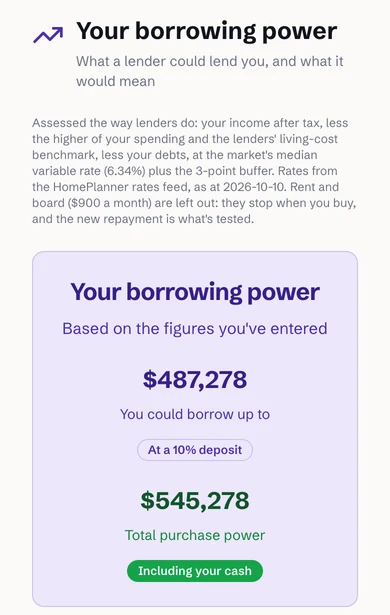
- How it's worked out: today's median variable rate plus the 3-point buffer lenders test at
- What a lender would lend, at your deposit size
- What you could buy, with your cash on top
Questions people ask
How much can I borrow on $100,000?
About $528,000 if you're single with no debts or children, at today's rates. One child brings it to about $474,000.
How much can I borrow on $80,000?
About $416,000 if you're single with no debts or children, and about $362,000 with one child.
How much can I borrow on $150,000?
About $775,000 if you're single with no debts or children. As a couple on $150,000 between you, about $731,000.
Why does my bank's calculator say something different?
Each lender tests you at its own rate plus 3% and uses its own living-cost benchmark, so bank calculators usually differ by a few percent. A calculator that doesn't ask about your debts, children or spending will show more.