Does HECS affect your borrowing power?
Yes, but not the way most people expect. Lenders count the compulsory repayment that comes out of your pay, not the balance you owe, so what HECS costs you depends on your income.
Figures at the median variable rate on 10 October 2026, from the same model as our borrowing power calculator.
Yes. A HECS or HELP debt reduces how much a lender will lend you, but not by the balance. Lenders count the compulsory repayment the ATO takes from your pay, as a monthly cost, the same way they count a car loan. On $100,000 that's $381 a month, which takes about $46,000 off your borrowing power.
Because it's the repayment that counts, two things follow. A big HECS balance costs no more than a small one, until it's small enough to clear within the year. And below the repayment threshold, HECS costs you nothing at all.
The 2026-27 repayment rates
Since July 2025, the repayment is worked out like income tax: a share of the income above a threshold, not a percentage of all of it.
| Repayment income | Compulsory repayment, 2026-27 |
|---|---|
| Up to $69,528 | Nil |
| $69,529 to $129,717 | 15c for each $1 over $69,528 |
| $129,718 to $186,050 | $9,028 plus 17c for each $1 over $129,717 |
| $186,051 and over | 10% of your total repayment income |
What HECS costs, by income
| Income | HECS repayment a month | Borrowing power without HECS | With HECS | Difference |
|---|---|---|---|---|
| $65,000 | Nil | $333,000 | $333,000 | None |
| $75,000 | $68 | $388,000 | $380,000 | −$8,000 |
| $90,000 | $256 | $472,000 | $441,000 | −$31,000 |
| $100,000 | $381 | $528,000 | $482,000 | −$46,000 |
| $120,000 | $631 | $628,000 | $552,000 | −$76,000 |
| $150,000 | $1,040 | $775,000 | $649,000 | −$125,000 |
The cost grows with income because the repayment does. Below $69,528 there's no repayment, so a lender has nothing to deduct.
When a lender will ignore it
Since 2025, lenders have been allowed to leave HECS out of the assessment if you'll repay it within about 12 months. APRA, the banking regulator, confirmed in June 2025 that this is acceptable, and some lenders, CommBank among them, said they'd do it. HECS also no longer counts towards the regulator's debt-to-income measure.
Whether a lender will set it aside is a lender's decision, case by case. If you're close to paying it off, ask the lender or broker before you apply, and have your current balance from myGov ready.
Should you pay it off before you buy?
Sometimes. Clearing a small balance removes the repayment and lifts your borrowing power straight away: for a $98,000 earner, by about $43,000. But it uses savings that would otherwise go into your deposit, and HECS carries no interest, only indexation. Work out both before you decide: what the extra borrowing buys you, and what the smaller deposit costs you, including any lenders mortgage insurance.
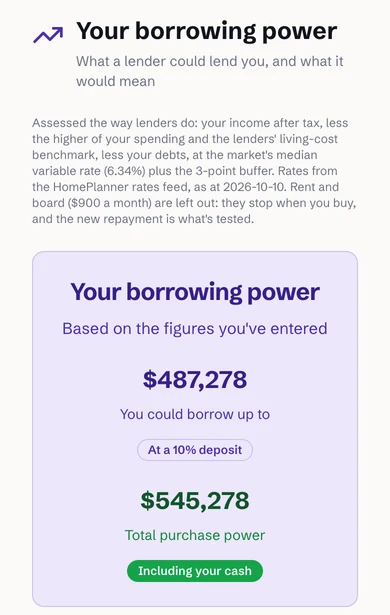
- How it's worked out: today's median variable rate plus the 3-point buffer lenders test at
- What a lender would lend, at your deposit size
- What you could buy, with your cash on top
Questions people ask
Does the size of my HECS debt matter?
Only when it's small. Lenders count the yearly compulsory repayment, which depends on your income. A balance smaller than a year's repayment counts at the balance instead.
Does HECS count towards debt-to-income?
Not for APRA's debt-to-income measure since September 2025. Some lenders may still look at it in their own policy.
My partner has HECS and I don't. Does it matter?
Yes. Each person's repayment is worked out on their own income, and lenders deduct the total from the household's surplus.
Will paying extra off HECS each year help?
Not until it's nearly gone. Voluntary repayments shrink the balance, not the compulsory repayment, so your borrowing power doesn't change until the balance falls below a year's repayment or will be repaid within about 12 months.