The guideGetting prepared7 min read
How lenders work out your borrowing power
The five steps every Australian lender follows to decide what you can borrow, one buyer worked through, and what the lender's number would mean for you.
By Paddy Carroll · Founder, HomePlanner
Your borrowing power is the most a lender will lend you. It isn't a share of your salary. It's the loan your budget could still repay if interest rates were 3 percentage points higher than today, after tax, after living costs and after every other debt, with nothing left over.
Every lender in Australia works it out the same way, in five steps. They differ in the details: the rate they test you at, the living-cost benchmark they use, and how they count things like bonuses and credit cards. That's why two bank calculators give you different answers, and why the answer is never just "five times your income".
The five steps
- 01
Income, as a lender counts it
Your pay after tax, worked out per person. Some kinds of income are counted at a discount.
- 02
Living costs
What you say you spend, or a benchmark for a household like yours, whichever is higher.
- 03
Your other debts
Credit cards at their limit, loan repayments, HECS. Each one is a monthly cost.
- 04
The rate you're tested at
The loan's rate plus a 3% buffer the regulator requires.
- 05
The loan your surplus could repay
Whatever is left each month, turned into the loan it would repay over 30 years at that tested rate, then checked against a cap on debt to income.
1. Income, as a lender counts it
Lenders start from your gross income and take tax off it the way the ATO would: per person, each with their own tax-free threshold, plus the 2% Medicare levy. A couple on $90,000 each pays less tax than one person on $180,000, but a couple's living-cost benchmark is higher, so the two end up within a few percent of each other.
| Taxable income | Tax rate, 2026-27 |
|---|---|
| Up to $18,200 | Nil |
| $18,201 to $45,000 | 15% |
| $45,001 to $135,000 | 30% |
| $135,001 to $190,000 | 37% |
| Over $190,000 | 45% |
Base salary counts in full. Other income is often discounted, because it might not last: lenders commonly count 80% of overtime and of an ongoing bonus or commission, and 75% of rental income. Some count less, or none, until you've earned it for a year or two. If you're self-employed, expect to be assessed on your last two years' tax returns.
2. Living costs: yours or the benchmark, whichever is higher
You'll be asked what you spend, and lenders check it against your statements. Then they compare it with a benchmark for a household like yours, by size, number of children and income, and use whichever is higher. Most use the Household Expenditure Measure (HEM) from the Melbourne Institute. Its figures are licensed to lenders and not published.
Rent and board aren't counted, because they stop when you buy. Everything else is: food, transport, utilities, insurance, childcare, school fees, subscriptions.
| Household | $75,000 | $100,000 | $150,000 |
|---|---|---|---|
| Single, no children | $1,820 | $2,080 | $2,780 |
| Single, one child | $2,270 | $2,530 | $3,210 |
| Couple, no children | $3,150 | $3,370 | $4,030 |
| Couple, two children | $3,900 | $4,120 | $4,790 |
Two things follow. If your real spending is below the benchmark, cutting it further won't raise your borrowing power, because the lender uses the benchmark anyway. And if it's above, every extra dollar a month you spend costs you about $120 of borrowing power at today's rates.
3. Your other debts, including the ones you don't use
Credit cards count at their limit
Not the balance. Lenders treat a card as if you'd spent the whole limit, commonly at 3.8% of the limit a month. A $6,000 card you clear every month still costs $228 a month in the assessment.
Loans count in full
Car loans, personal loans and leases are counted at the actual monthly repayment. A $400-a-month car loan is $400 a month less for a mortgage.
HECS counts as a repayment
Not as a debt. Lenders deduct the compulsory repayment that comes out of your pay. Since 2025, lenders may set it aside if you'll repay it within about 12 months, and it no longer counts towards the regulator's debt-to-income measure.
Buy now, pay later counts too
It has been regulated credit since June 2025. Lenders count it, though they don't all count it the same way.
4. The rate you're tested at
A lender doesn't ask whether you can afford the repayment today. APRA, the banking regulator, expects it to check you could still pay if the rate were 3 percentage points higher than the loan's, and reaffirmed that buffer in May 2026. At the median variable rate of 6.34%, you're tested at 9.34%.
This is why borrowing power falls when rates rise, even before your repayment changes: each rise moves the rate you're tested at as well. At today's rates, a 0.25% rise takes roughly $10,000 off a $98,000 earner's borrowing power.
5. The loan your surplus could repay
Whatever is left each month after living costs and debts is your surplus. The lender works out the loan that surplus would repay, principal and interest over 30 years, at the tested rate. That's your borrowing power.
Then one more check: debt to income. Since 1 February 2026, APRA has limited each bank to writing no more than 20% of its new home lending to borrowers whose debts are six or more times their income. That's a limit on the bank's whole book, not on you, but lenders also set their own caps, so a loan above six times your income gets a closer look. Most first home buyers don't reach it: the surplus test bites first.
Worked through: a single buyer on $98,000
One person, $98,000 a year, no children, spending about $1,800 a month apart from rent, a $6,000 credit card they pay off every month, no other debts, at the median variable rate of 6.34%.
| Each month | Amount |
|---|---|
| Income after tax | $6,343 |
| Living costs: the benchmark, as it's higher than their $1,800 | −$2,059 |
| Credit card limit of $6,000, at 3.8% | −$228 |
| Left to repay a loan | $4,056 |
Now change one thing at a time. These are the same buyer, recalculated:
| If they… | Borrowing power |
|---|---|
| Cancel the $6,000 card | about +$27,000 |
| Earn a $10,000 bonus (counted at 80%) | about +$37,000 |
| Take on a $400-a-month car loan | about −$48,000 |
| Have $25,000 of HECS | about −$43,000 |
| Have one child | about −$54,000 |
| Spend $3,000 a month rather than the benchmark | about −$113,000 |
| See rates rise 0.25% | about −$10,500 |
The card nobody uses is worth more than two quarter-point rate cuts. A $400-a-month car loan costs more than $25,000 of HECS. Your own inputs move the answer more than which bank you ask.
What the lender's number would mean for you
The lender's figure is the loan you could just repay if rates were 3% higher, living on the benchmark, with nothing left over. It's a ceiling, not a recommendation. For the buyer above, borrowing the full $489,000:
| Rate | Repayment a month | Share of take-home pay | Left after benchmark living costs |
|---|---|---|---|
| 6.34%, today | $3,041 | 48% | $1,244 |
| 7.34%, up 1% | $3,367 | 53% | $917 |
| 8.34%, up 2% | $3,706 | 58% | $578 |
| 9.34%, up 3% | $4,056 | 64% | $228 |
Nearly half their pay would go on the mortgage from day one. A common rule of thumb keeps the repayment to about 30% of take-home pay: for this buyer that's a loan of about $306,000, or about $251,000 if they want it to stay within 30% even if rates rise 2%.
Why calculators give different answers
- Different rates. Each bank tests you at its own rate plus 3%. A calculator that assumes a low rate will flatter you.
- Different benchmarks. Each lender sets its own living-cost floor and loadings, and some calculators don't ask about spending at all.
- Different treatment of debts. Card limits at 3% or 3.8% a month, HECS counted or set aside, bonuses at 80%, 50% or nothing.
- Missing questions. A calculator that doesn't ask about HECS, children or card limits can't take them off, so it will show more than a lender will lend.
A calculator gives you an estimate. A lender's answer comes from an application, and the one that counts is pre-approval.
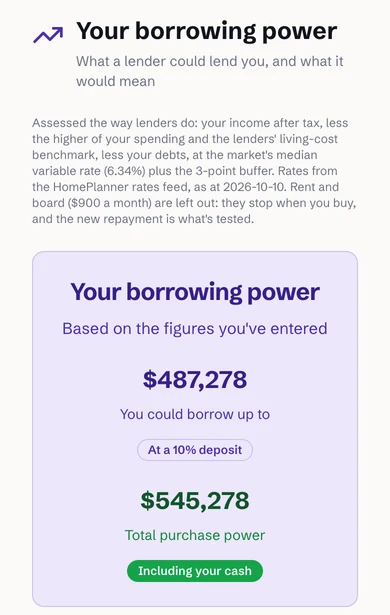
- How it's worked out: today's median variable rate plus the 3-point buffer lenders test at
- What a lender would lend, at your deposit size
- What you could buy, with your cash on top
Questions people ask
Does HECS affect borrowing power?
Yes, through the compulsory repayment taken from your pay, which lenders deduct as a monthly cost. In the example above, $25,000 of HECS takes about $43,000 off. If you'll repay it within about 12 months, ask your lender whether they'll set it aside: since 2025 they're allowed to. More in does HECS affect borrowing power.
Does a credit card I never use count against me?
Yes, at its limit. Closing a card you don't need, or lowering its limit, is the quickest way to raise your borrowing power: about $4,600 of borrowing per $1,000 of limit at today's rates.
Does a bigger deposit increase my borrowing power?
Not directly: borrowing power comes from your income and costs. A bigger deposit raises the price you can pay, avoids lenders mortgage insurance above 80% of the value, and can get you a better rate, which then helps a little.
Can a guarantor increase my borrowing power?
A guarantor's security can replace part of your deposit and remove mortgage insurance, but the lender still has to be satisfied that you can repay the loan from your own income. It helps with the deposit, not with the surplus test.
How much can I borrow on my salary?
A little over five times your income at today's rates if you have no debts or children, and less with them: a couple on $160,000 with two children comes out at about 4.3 times. The lender's surplus test, not a multiple, decides it, so the only way to know is to put your own numbers in. There's a table by salary in how much can I borrow on my salary.
Before you move on
- You know your income after tax, as a lender would count it
- You know whether the benchmark or your own spending applies to you
- Unused card limits are closed or reduced
- You know what your borrowing power is at today's rate plus 3%
- You've decided the repayment you'd be comfortable with, separately from the maximum