The guideHaven't started6 min read
How much deposit do you need for a house?
Why 20% is the number lenders use, what LVR and LMI mean, how to buy with 5% or less, and the costs that come on top of the deposit.
By Paddy Carroll · Founder, HomePlanner
The short answer is 20% of the price if you want to avoid lenders mortgage insurance, and as little as 5% if you don't mind paying it or qualify for a government guarantee. Then add the costs of buying on top, because most of them have to come from your own money.
The longer answer depends on three things: how the lender values the property, whether you'd pay LMI, and whether a scheme, a guarantor or family money changes the picture. This chapter goes through each.
Deposit, LVR and the 20% line
Lenders don't think in deposits. They think in LVR, the loan-to-value ratio: the loan as a percentage of the property's value. Borrow $450,000 to buy a $600,000 home and your LVR is 75%. The lower it is, the lower your costs and the better your chance of approval.
| Deposit | Cash | Loan | LVR | Lenders mortgage insurance |
|---|---|---|---|---|
| 20% | $120,000 | $480,000 | 80% | No LMI at most lenders |
| 10% | $60,000 | $540,000 | 90% | LMI usually payable |
| 5% | $30,000 | $570,000 | 95% | LMI payable, unless the 5% Deposit Scheme or a guarantor covers it |
The value in that sum is the lender's, not yours. Westpac, for one, works out 20% from the bank's valuation of the property. If the valuer comes in under the price you agreed, your deposit is a smaller share of their number, and the difference is yours to find. Getting finance and exchanging contracts covers what to do when that happens.
Why 20% is the number
Above an LVR of 80%, the lender will usually want lenders mortgage insurance. That's the whole reason 20% is the figure everyone quotes. It isn't a legal minimum, and plenty of people buy with less; it's the line above which lenders generally charge you for the risk of a small deposit.
| Price | 5% deposit | 10% deposit | 20% deposit |
|---|---|---|---|
| $500,000 | $25,000 | $50,000 | $100,000 |
| $750,000 | $37,500 | $75,000 | $150,000 |
| $1,000,000 | $50,000 | $100,000 | $200,000 |
What LMI is, and what it costs
LMI is insurance the lender takes out against you not repaying, and you pay for it. Moneysmart is blunt about it: it protects the lender, not you, and not your guarantor if you have one. It's usually a one-off premium, charged when the loan is set up.
- How you pay it. Up front with your own money, or added to the loan. Added to the loan, the premium and the stamp duty charged on it become part of what you owe, and you pay interest on them for as long as that part of the loan is outstanding.
- What it costs. The insurer sets the premium from your loan amount and LVR, and it can change with things like the loan's purpose, the type of borrower and the type of property. An estimate is only an estimate; the real figure comes from your lender at application.
- Monthly options. Helia, one LMI insurer, also offers the premium as a monthly charge rather than a lump sum. Ask your lender whether it's available on your loan, and what it costs in total.
Buying with 5% or less
Three ways get you to a home loan with a small deposit and no LMI:
The 5% Deposit Scheme
The federal government guarantees the gap between your deposit and 20%, so a participating lender writes the loan without LMI. Single parents can use a 2% stream. Property price caps apply and differ by location. How the government can help has the current caps and who qualifies.
A guarantor
A family member offers equity in their own property as extra security. You avoid LMI, and they take on real risk. Other ways to speed up a purchase goes through how to limit it.
A gifted deposit
Family money towards the deposit. Lenders will want a signed gift declaration, and a gift isn't a record of your own saving, which matters for the next section.
A 5% deposit is a bigger loan, not a cheaper house. You borrow 95% rather than 80%, the repayment is larger, and you start with very little equity if prices dip. The borrowing power calculator shows what the larger loan means each month.
Genuine savings
With a small deposit, many lenders want to see that at least part of it is genuine savings: money you've built up yourself over time, rather than a gift, a windfall or a sale that landed last week. The point is evidence that you can keep up repayments.
Each lender sets its own rule. Westpac, for example, asks for proof when the deposit is under 10%, and accepts either a record of regular saving or six months of rent paid on time. Others differ on how long the money must have been held and what counts. Ask early: it's much easier to start a visible saving pattern now than to explain a lump sum later.
The deposit you pay at exchange, and deposit bonds
There are two deposits in a purchase, and people mix them up. The one above is what the lender needs: the gap between the price and the loan, paid at settlement. The other is what the vendor asks for when contracts are exchanged, as a sign you're committed. At auction, Moneysmart's example is 10% on the day. It comes out of the same savings and counts towards the total at settlement, but you need it in cash weeks earlier. Reading the contract covers how much and where it's held.
A deposit bond stands in for that exchange deposit. A bond provider guarantees the vendor will get the deposit; you pay the provider a one-off fee, and pay the full price at settlement as normal. It isn't a loan and doesn't reduce the deposit your lender needs. If you fail to settle and the vendor claims on the bond, the provider will come to you for the money.
Bonds suit buyers whose deposit is real but not liquid on the day: tied up in a term deposit, in a property being sold, or in an FHSS release still being processed. Check the vendor will accept one before you rely on it, and read the provider's eligibility and fees.
The costs on top of the deposit
Moneysmart's savings goal is 20% plus enough for the costs of buying. Stamp duty in particular can't come out of the home loan, and it's typically due within 30 days of settlement, unless a first home buyer concession removes it.
- Stamp duty, the largest, and often nothing for first home buyers under your state's threshold. How the government can help has the thresholds.
- Conveyancing or legal fees, building and pest inspections, and loan fees such as application, valuation and settlement.
- LMI, if you pay it up front rather than adding it to the loan.
- Moving and the first bills. All things finances around property lists the lot, with a planning figure.
Can I buy a house with no deposit?
On your own, Moneysmart puts the floor at as little as 5%, with some lenders. With a guarantor, a family member's property can stand in for the deposit, but you still need your own money for stamp duty, which can't come out of the home loan, and the other buying costs.
Does a bigger deposit mean I can borrow more?
No. What a lender will lend depends on your income, spending and debts. A bigger deposit lets you pay a higher price with the same loan, lowers your LVR, and can avoid LMI.
Is the 20% worked out on the price or the valuation?
On the lower of the two. Helia, an LMI insurer, divides the loan by the lesser of the purchase price and the valuation, and Westpac works out 20% from the bank's valuation. If the valuation comes in low, you need more deposit or a smaller loan.
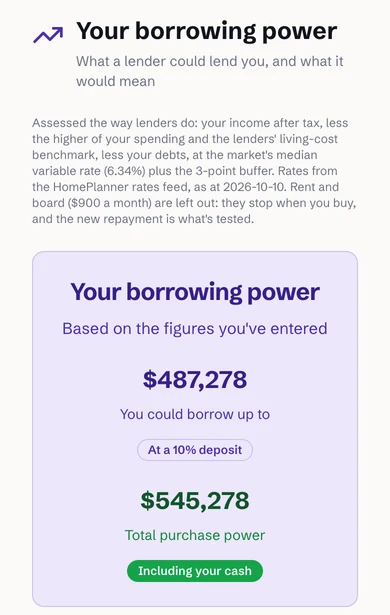
- How it's worked out: today's median variable rate plus the 3-point buffer lenders test at
- What a lender would lend, at your deposit size
- What you could buy, with your cash on top
Before you move on
- You know the deposit you're aiming for, as a dollar figure
- You know whether you'd pay LMI, and have a real quote if so
- You've checked whether the 5% Deposit Scheme or a guarantor applies to you
- You know your lender's genuine savings rule
- Your savings target includes stamp duty and the other buying costs