The guideFound a home3 min read
Settlement and moving in
What happens in the last six weeks, the costs that surprise people, and the inspection you get one chance at.
By Paddy Carroll · Founder, HomePlanner
Settlement is the day money and title change hands. Between exchange and that day is typically 30 to 90 days — around 42 in New South Wales, and six weeks is a fair rule of thumb elsewhere. It is mostly your conveyancer's work, and mostly quiet, right up until the last week.
What your conveyancer is doing
- Searches. Title, planning, council rates, land tax, whether anything is registered against the property that shouldn't be.
- Adjustments. Council rates, water and strata levies are apportioned between you and the vendor to the day. This is why the final figure moves in the last week.
- Coordinating with your lender so the money is available and the mortgage is registered at the right moment.
- Settlement itself, now electronic almost everywhere, which is why it happens at a scheduled time rather than with a room full of people.
There is no standard conveyancing fee. Some charge a flat fee, some by the hour, and the range for a straightforward purchase is roughly $700 to $1,300. Ask what is included and what counts as an extra before you engage them, not after.
The costs that surprise people
Everyone budgets the deposit. Fewer people budget the rest, and in one state the largest line can be zero or enormous depending on a single threshold.
An $800,000 purchase in NSW by a first home buyer. Deposit excluded.
- Stamp dutyNone up to $800,000 for a NSW first home buyer; above it a concession tapers to $1m. Thresholds by state
- $0
- ConveyancingTypically $700 to $1,300 for a standard transaction
- $1,000
- Building and pestPaid weeks earlier, and still part of the bill
- $550
- Before you have the keys
- $1,550
The pre-settlement inspection
Usually the morning of settlement or the day before, and you get one shot at it. The property must be in the condition the contract describes — which is the condition you saw, not the condition it was photographed in.
- Everything in the inclusions list is still there. Dishwasher, light fittings, curtains, the shed — the list you agreed in the contract. Bring it.
- Nothing has broken since. Run the taps, flush, test the hot water, switch on the oven and every light.
- Damage from the vendor moving out. Walls, floors, door frames. It happens often and it is easiest to raise now.
- The place is empty and clean, including the garage, the shed and whatever is behind them.
- Keys, remotes, alarm codes and manuals are accounted for.
Settlement day, and the fortnight after
- 01
Settlement happens without you
Electronically, at a scheduled time. Your conveyancer confirms it went through. Keys are usually released by the agent shortly after, though not always instantly.
- 02
Connect things
Electricity, gas, water, internet. Internet is the one with a lead time — arrange it well before the day rather than discovering a two-week wait.
- 03
Update the address
Electoral roll, licence, bank, insurer, employer, Medicare. Mail redirection for a few months covers what you forget.
- 04
Check the first repayment date
It is often not a month after settlement, and rarely aligned to your pay cycle. Know the date and the amount before it arrives.
Then it is yours. The guide has taken you from wondering whether this was possible to holding the keys, and the last thing worth saying is that the first year is cheaper to plan than to improvise: the first repayment, the first rates notice, the first strata levy and the first repair all arrive sooner than they feel like they should.
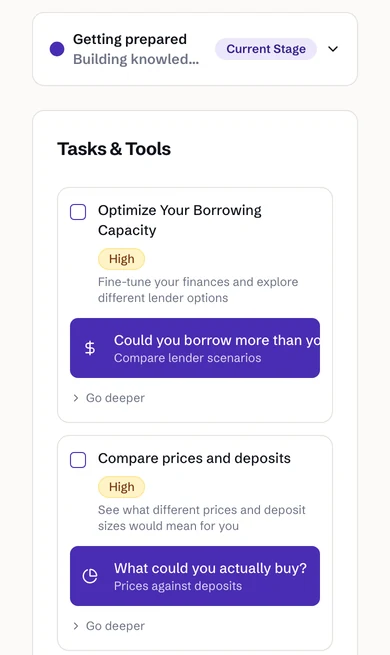
- Your stage, the same four the guide uses
- Each task opens the tool that does it
Before you move on
- Conveyancer engaged and you know what their fee includes
- You've budgeted the costs beyond the deposit, not just the deposit
- Pre-settlement inspection booked, with the inclusions list in hand
- Utilities and internet arranged before settlement day
- You know the date and amount of your first repayment