We asked 12 borrowing power calculators about the same four buyers
The nine bank calculators mostly agreed with each other. The outliers weren't banks. And what changed the answer most was what the buyer told them, not which bank they asked.
By Paddy Carroll · Founder, HomePlanner
On 10 October 2026 we ran four made-up first home buyers through 12 of Australia's online borrowing power calculators: nine banks, a broker, a property portal and a comparison site. Same incomes, same debts, same families, entered the same way. Two days later we ran them all again, and every figure came back the same to the dollar.
The four buyers
| Buyer | Income | Family and debts |
|---|---|---|
| A | $98,000 | Single, a $6,000 credit card |
| B | $75,000 | Single, a $3,000 credit card, $25,000 of HECS |
| C | $90,000 + $70,000 | Couple, one child, $10,000 of credit cards, a $400-a-month car loan |
| D | $150,000 + $120,000 | Couple, two children, no debts |
The banks agreed more than you'd think
| Buyer | Lowest bank | Highest bank | Middle of the nine | Times income |
|---|---|---|---|---|
| A | $467,000 | $498,000 | $476,100 | 4.9 |
| B | $343,900 | $369,900 | $361,000 | 4.8 |
| C | $577,000 | $665,000 | $641,600 | 4.0 |
| D | $1,227,000 | $1,379,000 | $1,330,000 | 4.9 |
For the single buyer on $98,000, nine bank calculators were within about 7% of each other. For the couple on $270,000 with two children, about 12%. Debt-free, the middle answer was close to five times gross income.
The differences come from each bank's own rules. Each assesses you at its own interest rate (from 6.09% to 6.79% that week) plus the 3% buffer APRA requires. Each has its own allowance for children: one major bank took about $37,000 off the couple's borrowing for each child, another about $56,000 per child for a single parent. And each sets its own floor for living costs.
Debts spread them out
Buyer C has a car loan, card limits and a child. For them the banks ranged from $577,000 to $665,000: $88,000 apart, the widest gap of the four. Each bank counts debts its own way, so the more of them you have, the more it matters which calculator you believe.
What you tell them matters more than which bank you ask
Our own calculator follows the banks' method and lands within 3% of their middle answer for all four buyers. Here's what it says each of these is worth to the $98,000 buyer:
| Change | Borrowing power |
|---|---|
| A $400-a-month car loan | about −$48,000 |
| $25,000 of HECS | about −$43,000 |
| A $6,000 credit card limit, even if it's paid off every month | about −$27,000 |
| A 0.25% rate rise | about −$10,000 |
The gap between the most and least generous bank, for this buyer, is $31,000. A car loan is worth more than that. So is HECS. A card nobody uses is worth nearly as much.
The outliers weren't banks
- A comparison site's calculator defaulted to a 4.00% interest rate, about 2% below what lenders were charging, and had no field for living costs. It returned 1.6 to 1.8 times the banks' middle answer.
- A second comparison site, which we could only reach on the re-run, erred the other way. At its default 7% rate, counting 80% of income, it returned two-thirds to three-quarters of the banks' figure.
- Only two of the 12 calculators asked about HECS.
- A broker's calculator we also tried asked for a first name before it would show anything, so it isn't in these figures.
The most a bank will lend isn't a comfortable amount
At the banks' middle figure, the $98,000 buyer's repayment would take about 47% of their take-home pay at the median rate, and about 62% if rates rose 3%. A lender's figure is the loan you could just repay in that scenario, on a benchmark budget, with nothing left over. It's a ceiling, not a recommendation.
That's why we built our borrowing power calculator to show both. It works the way the banks do, at today's median rate from our rates feed, then shows what the loan would mean month to month, if rates rise, and a comfortable amount by a rule you set.
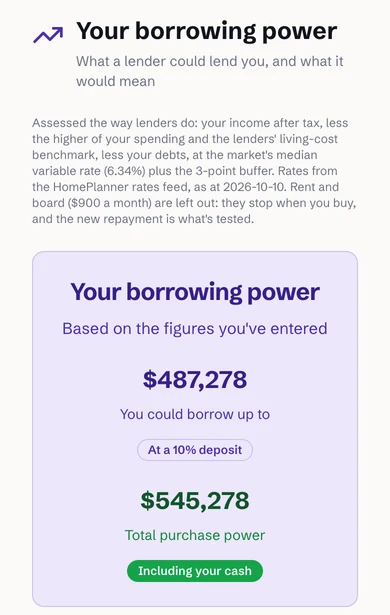
- How it's worked out: today's median variable rate plus the 3-point buffer lenders test at
- What a lender would lend, at your deposit size
- What you could buy, with your cash on top
How we did it
Four made-up buyers, entered into each calculator's own public form on 10 October 2026 between 8pm and 9pm AEDT, and again on 12 October between 6:30 and 7am, with identical results. No contact details were entered and nothing was submitted. The figures are the maximum loan each calculator displayed. Where a calculator asked for something different, such as after-tax income or a postcode, we converted the same inputs. For how lenders work it out, see how lenders work out your borrowing power.