Four rate rises in 2026: what they've done to your borrowing power
The cash rate is 4.60% after the RBA's fourth rise this year. Repayments are the obvious cost. The bigger one, for a first home buyer, is how much less a lender will now let you borrow.
By Paddy Carroll · Founder, HomePlanner
Updated
On 29 September the Reserve Bank raised the cash rate by 0.25 percentage points to 4.60%, its fourth rise of 2026. It said inflation remains elevated and that risks it flagged in August were materialising. The three cuts of 2025 have been more than undone: the rate is a full point higher than it was at the start of the year.
CBA has passed the latest rise on in full to its variable home loans from 9 October, and the other big banks have been reported to be doing the same. If you already have a loan, the cost shows up in your repayment. If you are still saving, it shows up somewhere less visible: in how much a lender will let you borrow.
The year in rates
| Effective | Change | Cash rate |
|---|---|---|
| 19 February 2025 | Cut 0.25 | 4.10% |
| 21 May 2025 | Cut 0.25 | 3.85% |
| 13 August 2025 | Cut 0.25 | 3.60% |
| 4 February 2026 | Rise 0.25 | 3.85% |
| 18 March 2026 | Rise 0.25 | 4.10% |
| 6 May 2026 | Rise 0.25 | 4.35% |
| 30 September 2026 | Rise 0.25 | 4.60% |
Why a rate rise shrinks your borrowing power
A lender doesn't check whether you can afford the repayment at today's rate. APRA, the banking regulator, expects it to check whether you could still pay if the rate were 3 percentage points higher. That is the serviceability buffer, and APRA confirmed in May that it is staying at 3 points.
So every rise moves the rate you are tested at as well as the rate you pay. If your loan rate goes from 5% to 6%, the lender now tests you at 9% rather than 8%, and the most you can borrow falls with it.
Worked through: a full point of rises
Take a variable rate of 5.00% at the start of February, passed on in full at each of the four rises, so it is now 6.00%. These are round numbers to show the effect, not a quote: check your own lender's rate. Assume no children, no other debts and living costs at the benchmark lenders use, over 30 years.
Before the rises
Loan rate 5.00%, tested at 8.00%
- Single, $100,000 income
- About $596,000
- Couple, $100,000 and $80,000
- About $1,007,000
- Repayment on a $600,000 loan
- About $3,221 a month
After four rises
Loan rate 6.00%, tested at 9.00%
- Single, $100,000 income
- About $544,000
- Couple, $100,000 and $80,000
- About $918,000
- Repayment on a $600,000 loan
- About $3,597 a month
That is roughly $52,000 off a single buyer's maximum loan and $89,000 off a couple's, about 9% in each case, or about $13,000 per $100,000 of income for every quarter-point rise. Lower house prices help: the Council of Financial Regulators said in September that tighter financial conditions had contributed to falling prices. But a buyer whose budget was sized in January is now looking at a smaller loan as well as a different market.
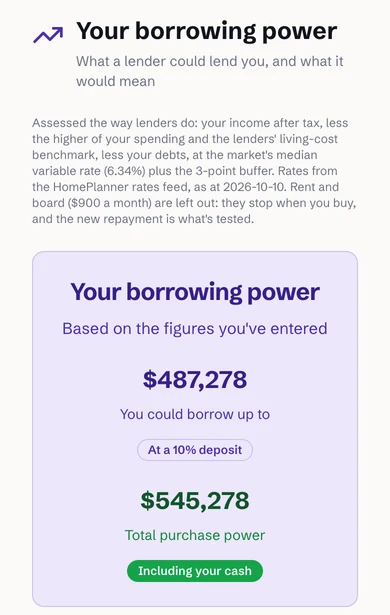
- How it's worked out: today's median variable rate plus the 3-point buffer lenders test at
- What a lender would lend, at your deposit size
- What you could buy, with your cash on top
The argument about the buffer
Run the same example the other way and the uncomfortable arithmetic appears. Testing at 2 points above the rate instead of 3 would put the single buyer back at about $596,000, exactly where they started the year. A one-point cut in the buffer hands back what four rate rises took away.
That is why lowering the buffer is a recurring proposal, and why the regulators resist it. The buffer is there for borrowers who stretch furthest. The RBA's October Financial Stability Review found fewer than 1% of borrowers owe more than their home is worth today, but that around 5% of mortgages would if prices fell 20%, and that recent buyers and those with small deposits are the most likely to be among them. Those are first home buyers.
One more limit you may not know about
Since 1 February 2026, APRA has limited banks to writing no more than 20% of new owner-occupier loans at six or more times the borrower's income, and the same for investor loans. It is a cap on the bank's lending as a whole, not a rule for each borrower, but if your loan would be six times your income or more, you are competing for a limited share of each lender's book.
What to do now
- Recalculate your borrowing power at today's rates before you set a price range. A pre-approval from earlier in the year was assessed at a lower rate.
- If you have a pre-approval, ask your lender or broker whether it still stands at the current rate, and for how long.
- Check the government schemes again. The 5% Deposit Scheme lets you buy with a smaller deposit and no lenders mortgage insurance, but it doesn't change how much you can borrow.
- Leave room. The RBA announces its next decisions on 3 November and 8 December, and a lender tests you 3 points above whatever the rate is then.